The advantages of contactless payment go beyond tapping a card at the counter. For cafés, takeaway shops, food trucks and other busy food businesses, customers can also use their phones to browse, order and pay without needing to reach the counter first.
While tap-to-pay can make the final payment faster, QR ordering and order-ahead can remove several steps from the counter altogether. Customers can place paid orders from their own phone, helping businesses reduce queues, capture orders earlier and take pressure off staff during busy periods.
What Are Contactless Payments and QR Code Ordering?
Contactless payments let customers pay by tapping an eligible debit or credit card, smartphone or wearable device against a payment terminal. These transactions generally use near-field communication (NFC) to transfer payment information over a short distance.
Mobile wallets such as Apple Pay and Google Pay work in a similar way, allowing customers to pay using a phone or compatible device instead of a physical card.
QR ordering takes the contactless experience a step further. Instead of waiting until they reach the counter to pay, customers can scan a QR code, view the menu, place their order and pay online from their own phone. Order-ahead can extend this further by allowing customers to complete the process before they arrive.
The key difference is that contactless payments make the final transaction faster, while QR ordering can reduce the need to queue at the counter to browse, order and pay in the first place.
What Are the Advantages of QR Code Ordering Over Contactless Payments?
Contactless payments offer convenience and faster transactions, but QR code ordering can remove even more steps between a customer deciding to buy and completing their purchase.
For food venues, the biggest advantage is giving customers the option to browse, order and pay without waiting to reach the counter.
Customers Can Order and Pay Without Joining the Counter Queue
Tap-to-pay makes the transaction at the counter faster. QR ordering can remove the need to reach the counter to order in the first place.
A customer can scan a QR code from their table, signage or another visible location, view the menu and place a paid order from their phone.
This can be particularly useful during busy service periods when several customers arrive at once. Rather than every order needing to pass through the same counter, customers can order independently while staff focus on preparing and fulfilling orders.
Less Pressure During Busy Service Periods
Payment is only one part of the traditional ordering process.
At a busy counter, staff may need to:
- answer menu questions
- take the customer’s order
- enter the order
- process payment
- provide change or operate the payment terminal
- explain collection or wait times
Contactless card payment can speed up one of those steps. QR ordering and mobile payments can move several of them onto the customer’s phone.
That can reduce pressure at the counter and give staff more time to focus on preparation, customer service and getting orders out.
Capture Paid Orders Before Customers Arrive
Order-ahead takes contactless ordering beyond the venue itself.
Instead of arriving, joining a queue and placing an order, customers can follow an online ordering link from a website, Google Business Profile, social media page or other digital channel.
They can browse the menu, order and pay before arriving.
For a café, that might mean receiving a coffee order while the customer is still on their way to work. For a takeaway shop, it could mean starting a lunch order before the customer reaches the venue.
Capturing paid orders earlier gives the business more visibility over upcoming demand and can make pickup more efficient.
A Convenient Way for Customers to Pay
Australian consumers are already comfortable using their phones for payments.
The Reserve Bank of Australia’s 2025 Consumer Payments Survey found that 43% of consumers used a mobile device to make a contactless payment during the survey week, up from 35% in 2022.
QR ordering builds on that familiarity. Customers use a device they already carry to browse, order and pay without downloading an app or learning an unfamiliar ordering process.
Reduce Reliance on Cash and Counter Hardware
Contactless payments can reduce the amount of cash a business needs to handle during service.
Phone-based ordering can also reduce how dependent the ordering process is on the payment terminal itself. Customers complete their order and online payment from their own device instead of every transaction needing to pass through one counter terminal.
This can be useful for food trucks, market stalls and other mobile businesses where space is limited and queues can form quickly.
Contactless Payment vs QR Ordering: What Is the Difference?
Contactless card payments, QR ordering and order-ahead can all make paying easier, but they improve different parts of the customer journey.
Contactless Tap-to-Pay | QR Ordering | Order-Ahead | |
Customer can pay digitally | ✓ | ✓ | ✓ |
Customer uses their phone | Optional | ✓ | ✓ |
Customer can avoid ordering at the counter | ✕ | ✓ | ✓ |
Customer can order before arriving | ✕ | Limited | ✓ |
Can reduce time spent processing payment | ✓ | ✓ | ✓ |
Can reduce pressure on the ordering counter | Limited | ✓ | ✓ |
Requires every customer to reach a payment terminal | Usually | ✕ | ✕ |
For many food venues, these methods do not need to replace each other.
A café can continue accepting contactless card payments from walk-in customers while also offering QR ordering and order-ahead. A food truck might keep its payment terminal at the service window while displaying a QR code for customers who want to browse, order and pay from their phone.
The goal is to give customers more ways to order while reducing how much demand needs to pass through a single service point.
Are There Any Disadvantages to Contactless Payments?
Payment Processing Fees
Businesses may pay transaction or payment processing fees depending on the provider and payment method used.
Australian card surcharge rules are also changing. From 1 October 2026, Visa, Mastercard and eftpos card networks can introduce rules preventing businesses from applying surcharges to prepaid, debit and credit card payments processed through their networks. Businesses should check the current rules and the terms provided by their payment provider when deciding how payment costs will be handled.
Reliance on Technology
Online ordering and digital payments depend on functioning devices, payment services and connectivity.
Businesses should understand what happens if their internet connection or payment service becomes unavailable and have a suitable backup process where practical.
Not Every Customer Wants to Order Digitally
Some customers will still prefer ordering directly with a staff member or paying using another method.
For many venues, the strongest setup is not replacing the counter altogether. It is giving customers another way to order when they want a faster option.
Faster Ordering Does Not Automatically Mean Faster Preparation
Moving ordering and payment away from the counter can improve the ordering process, but it does not increase kitchen capacity.
Businesses still need to manage preparation times, incoming order volumes and collection carefully.
The benefit is that staff can spend less time manually processing orders and more time fulfilling them.
Is Contactless Ordering Right for Your Business?
For most food businesses, the question is no longer simply whether to accept contactless card payments.
It is worth considering how much of the ordering process needs to happen at the counter at all.
If customers regularly queue to read the menu, place an order and pay, QR ordering can give them another option. If customers know what they want before arriving, order-ahead can allow the business to capture that sale earlier.
When reviewing your setup, consider:
- Peak service periods: Are queues forming because too many customers need staff attention at the same time?
- Ordering behaviour: Could regular customers place their usual order before arriving?
- Counter space: Would moving some orders onto customers’ phones reduce congestion?
- Staff workload: How much time does your team spend manually taking and processing orders?
- Customer choice: Can customers still order directly with staff when they prefer to?
Contactless payments are a useful way to speed up transactions at the counter. QR code ordering can take that convenience further by allowing customers to browse, order and pay from their phone without joining the counter queue.
Let Customers Order and Pay Without Waiting at the Counter
Y Wait gives food venues another way to capture orders without replacing the systems they already use.
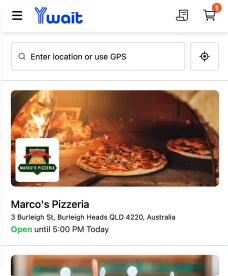
Customers can scan a QR code or follow an online ordering link, view your menu, place their order and pay from their own phone. They can receive updates when their order is ready, while your team receives paid orders as they come in.
There is no new ordering hardware for your venue to purchase, and Y Wait can work alongside the payment options you already provide at the counter. Y Wait currently offers a three-month free trial with no lock-in contract, giving venues a way to test QR ordering and order-ahead before committing to a paid plan.
Start your free trial and give customers a faster way to order.